
Moroccan women writers turn book signings into a human moment
Moroccan women writers have chosen to approach their works and themselves in meetings that reflect the diversity of experiences and reveal multiple faces of women's writing.
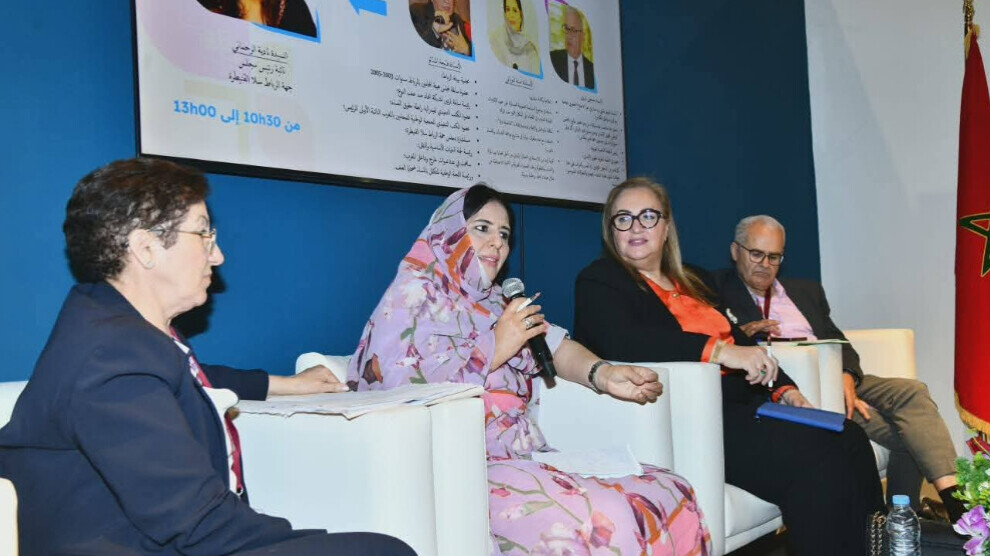
Hanane Hart
Morocco – Inside the corridors of the 31st edition of the International Book Fair, held from May 1 to 10, the book signing moment is not reduced to its celebratory dimension; instead, it turns into a living space for direct communication between women writers and their readers, where texts leave their pages to enter an open human dialogue.
In various pavilions of the fair, Moroccan women writers chose to meet their audience, each from her own position, in a scene that reflects the diversity of women's experiences within the literary landscape and their intersections between the personal and the human, and between the local and its universal questions.
Her works are based on two dimensions
Novelist Soumaya Qarfiadi believes that book signing constitutes a human and historical milestone in the writer's path, going beyond promotion to highlight the issues she believes in.
Her works are based on both human and political dimensions, drawing inspiration from history and reality alike, as in her novel "Her Ghost Haunts Me," which addresses social issues extending from the past to the present, in a narrative that combines pain and hope. In other texts, she employs symbolism through the anthropomorphism of animals to express human suffering.
Regarding women's writing, Soumaya Qarfiadi sees that it does not differ in its essence from writing in general, but she points out that in recent years women have been able to break a number of societal restrictions and express themselves more freely, reflecting their human experience and existential struggle.
Texts that touch everyone
In a different approach, writer Karima Ahdad presented her short story collection "A Wound Below the Belly," published by Al‑Mutawassit Publications, marking her return to short fiction.
The collection deals with stories of Moroccan women from unconventional angles, united by a feeling of alienation within a contemporary world experiencing tension between clinging to traditions and aspiring to freedom and modernity.
She believes that personal experiences can turn into general themes within literary texts; indeed, the most intimate experiences are those that touch others, regardless of differences in culture, color, or religion. She gives as an example shared human experiences such as love, or fear of illness and death – experiences that spring from within and are very personal, yet at the same time capable of addressing everyone.
Regarding writing about women, Karima Ahdad believes that women have a great ability to express their suffering within literary texts, but she affirms that creativity is not linked to the writer's gender, pointing to many examples in world literature of male writers who were able to present strong, complex, and contradictory yet coherent and convincing female characters.
She adds that the opposite is also possible: there may be women writers who do not necessarily succeed in accurately expressing women's suffering or the details of their lives, considering that the matter will remain relative and linked to the writer's creative ability, not to their gender.
Love of country in art
In the pavilion of the League of Moroccan Women Writers, writer Touria Rachdi chose to meet her readers through her zajal (Moroccan dialect poetry) collection "Al‑Azza Biladi" (My Country's Glory), placing love of country at the core of her writing experience. She directs her texts, which blend zajal and Arabic, to wide audiences, especially young people, calling for supporting them rather than burdening them with responsibility alone. She also draws inspiration from her personal experience, including letters addressed to her daughter, in an attempt to open a dialogue with the new generation.
The signing moment does not stop at the meeting; it extends to include live interaction, where reading turns into vocal performance, and words become closer to the audience when spoken spontaneously and from the heart, as Touria Rachdi affirms, seeing delivery as an additional bridge between the text and its audience.
At the conclusion of this open meeting between women writers and their readers, experiences intersect and styles differ, but the common denominator remains the same: writing that springs from the self and seeks its echo in others, within a cultural space that goes beyond presentation to build deep human connections.