
Deniz Firat... The Journalist Whose Name Was Immortalized in the Pursuit of Truth
Twelve years after her death, journalist Deniz Firat's courage in conveying truth and documenting ISIS suffering endures through her camera and diaries, leaving a lasting journalistic and humanitarian legacy.
News Center — August 2014 left indelible marks on the world's memory in the geography of the Middle East—a time when women were abducted, subjected to harassment, rape, and torture beyond the capacity of human conscience to absorb; when hundreds were killed within hours, not days; when mass graves were opened one after another; and when slave markets were established.
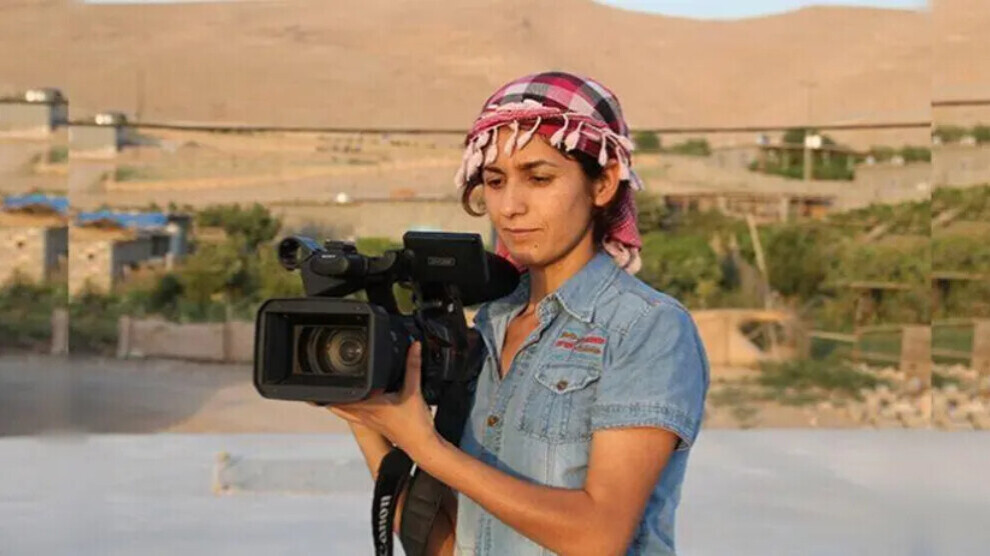
In these lands that witnessed developments of a kind one might say "could not happen in this century," the hands that pressed the camera's shutter succeeded in conveying all these events to the world. Among those who used that camera was journalist Deniz Firat, one of the workers in free journalism.
Twelve years have passed since the passing of Deniz Firat (Leyla Yıldız Tan), who conveyed to the public the ISIS attacks on Makhmur and Shingal. She lived a very difficult life in her youth, yet at the same time a life of great meaning.
Deniz Firat was born in 1984 in the village of Hengedik (Khaci Khatun) in the Çaldıran district of Van province, North Kurdistan. She encountered war and displacement while still in childhood. Her story and her family's story embodied the tale of thousands of Kurds who faced attempts at annihilation.
Her Life Unfolded Between Repression and Resistance
Deniz Firat's character was shaped through her experience of repression, injustice, imprisonment, exile, and pain from childhood. Due to pressures and repressive policies in Turkey, her family was forced to migrate toward Eastern Kurdistan. There too, they faced pressures from the Iranian regime, prompting them this time to direct their compass toward the Khakurk region.
The family settled in the Khakurk mountains in 1991, witnessing the betrayal war of that year. Deniz Firat's elder sister, Ayfer Yıldız Tan (nom de guerre: Benafsh), was the first from the family to join the ranks of the freedom movement. Following in Benafsh's footsteps, Deniz Firat later joined the freedom movement along with her younger sister Şükran Yıldız Tan (nom de guerre: Sariya Risho). Afterward, the family moved in 1992 to the Zeli region, and then to the Makhmur refugee camp. The two sisters lost their lives at different times on the path to freedom.
She Always Conveyed the Truths
Deniz Firat, described by her comrades with words such as "diligent and friendly," always strived to deliver the truth to the world. She would send news and video footage from the mountains to Kurdish channels. For many years, she participated in free journalism work; she was a member of the administrative body of the Free Media Union (YRD), and an editor and writer for the weekly newspaper "Rojev" published in Makhmur.
She worked as a war correspondent in the Kurdistan Region, following on the ground the attacks targeting Makhmur and the resistance mounted against them. She conveyed the truths from the battlefields to the world with her camera and microphone. Through her close monitoring of events in Makhmur camp, Deniz Firat documented all moments of the war and became a voice for the people.
On August 8, 2014, while covering the ISIS attacks on Makhmur, she lost her life in an attack by ISIS elements, joining the caravans of the immortal in free journalism. Today, Deniz Firat remains a torch illuminating the path for dozens of young women through her determination and courage.
"An Oak Tree"
Deniz Firat's comrades, who compared her to an oak tree, explained that she possessed an authentic structure and deep roots like the tree itself, constantly renewing herself to grow stronger.
In an interview with our agency, her mother Sultan Yıldız Tan said: "On the night ISIS attacked and the camp was evacuated, she had dressed as a guerrilla (Peshmerga) in the mountains and was capturing scenes with her camera in hand. Her two older brothers were also beside her. On the night her brothers left, she attained martyrdom. During the path of displacement and migration, news of her martyrdom reached us. According to her will, we buried her in Van province."
She added: "She would constantly tell me: 'Mother, if we ever go to Van one day, we will sit by Lake Van and drink tea together.'" She explained that her other two daughters carried Deniz's camera after her passing and began working in journalism, noting that many young men and women are following in Deniz Firat's footsteps and adopting her struggle.
"The World Will Fill with Love and Freedom"
In the diaries she kept, journalist Deniz Firat wrote: "Lovers of freedom with small hearts. One day they will grow up and will not be ashamed of themselves; because with their small hands they throw stones at those who kill hope. For this reason, they will not ask: 'If the forests disappear, if the trees perish, what will I tell the children who come after me...' And so that this does not happen, they disappear forcibly under the weight of detention. Even if they are unaware, they are abducted simply for being Kurds. They are raped. They are not only made to disappear in the darkness of detention; they want to take everything from them there. They are abducted from in front of their doors and made to disappear. They are killed in their mothers' arms and laps; the mother looks at the lifeless body and says: 'Let this one also be a hero of peace.'"
"Jilan, Uğur, İlyas..."
In her diaries, she also wrote: "Today again, a four-year-old child disappeared. Why? Because he is Kurdish... Being Kurdish is the reason for disappearance, or the reason for killing. Jilan, Uğur, İlyas, Muhammed, Kamuran, and others like them. Thousands of Kurdish children have been killed. Why? Because they were lovers of hope and freedom, and with their small hands they became makers of freedom. They learned not to betray their childhood dreams, and for this reason, they gathered stones and hid them in their chests. Sometimes they slept with stones placed in their arms. On dark nights, they would warm the stones they had clutched in their palms while in their beds, turning them into a fire for freedom."
"They Slept with Stones in Their Arms"
In her diaries, she focuses on condemning the targeting of the Kurdish people and the children's resistance to this targeting and marginalization: "Is being Kurdish the crime for which we are killed? Yet the stones in the children's hands say: 'This is not fate; this is the pursuit of freedom.' A child asks his mother: 'Mother, has the world become polluted because we grew up?' The world of adults is polluted—it has war, killing, deception, and betrayal, and they make the child a victim of their filthy world. Then the child says: 'When I grow up, I will eliminate all these things.' For this reason, when they go to sleep, they take their stones to their beds and sleep with them. They do this also to defend their dreams."
She adds: "Then, any step that will be taken will be a means for the flourishing of children's hopes, and every step of struggle will bring us a little closer to their world—that pure and boundless world. And when we become lovers of these children beloved by freedom, the face of the world will spread with love and freedom."