
Crimes Without Accountability Amid International Silence Over Sheikh Maqsoud and Ashrafieh Violations
Recent developments in neighborhoods of the Syrian city of Aleppo have raised growing human rights concerns over serious violations that may amount to war crimes, alongside systematic attempts to evade accountability and politicize justice.
Zeinab Khalif
Deir ez-Zor — Video clips have circulated documenting the mutilation of the body of a female fighter in the Sheikh Maqsoud neighborhood of Aleppo, the extraction of a fighter’s heart, and other footage showing insults and abuses against civilians by jihadists from Hayat Tahrir al-Sham and mercenaries affiliated with the Turkish occupation. These shocking scenes reflect an extremely dangerous level of violence and constitute a blatant violation of international humanitarian law.
Mercenaries of the Turkish occupation, namely the “Amshat” and “Hamzat” factions, participated in the attacks on the Kurdish neighborhoods of Aleppo. Although they have been incorporated under the banner of the interim government forces, they remain a tool used by Turkey in Syria, moved according to its interests.
Moreover, a truly national Syrian army that includes all Syrians and is ideologically loyal to Syria has not been established. Instead, factions continue to operate in pursuit of interests far removed from the national interest. This was evident in the repeated provocations against the Internal Security Forces (Asayish) over the past period, ranging from limited attacks and sieges to large-scale assaults aimed at achieving demographic change.
Women from Deir ez-Zor Canton in the Autonomous Administration of North and East Syria considered that reliance on “factions under international sanctions” to manage military operations represents a political instrumentalization of justice, by placing responsibility for crimes on these groups rather than holding the supporting and supervising parties accountable. This entrenches a climate of impunity and undermines prospects for legal accountability.
Indirect Complicity in Violations
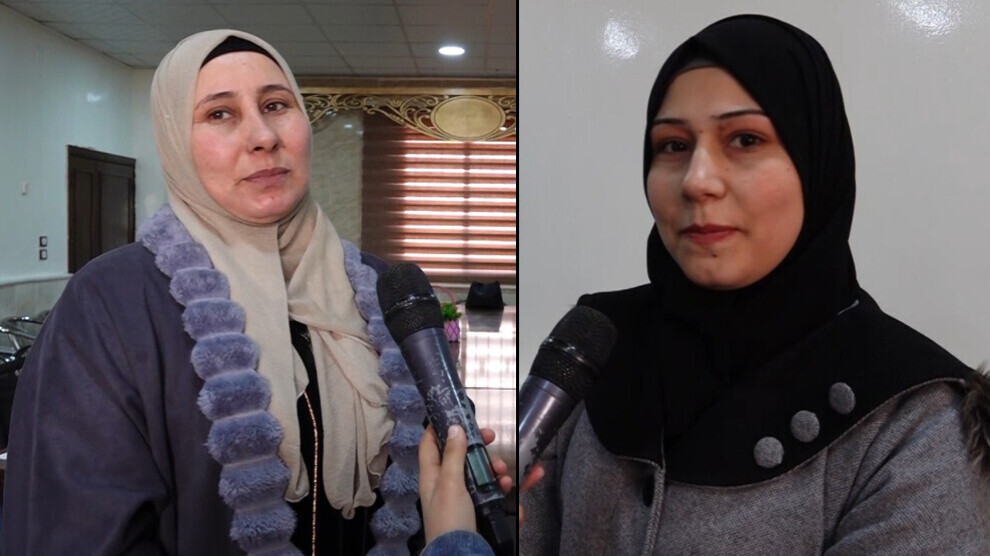
Alaa Al-Daher, a member of the Child Protection Office, stated that the international silence regarding what occurred in the Sheikh Maqsoud and Ashrafieh neighborhoods constitutes indirect complicity in the violations committed against civilians. She stressed her rejection of the violations, which starkly contradict what was announced regarding a ceasefire.
She explained that the intense shelling resulted in a humanitarian tragedy for civilians, especially children, who are living in a constant state of fear and insecurity.
For her part, Iman Habshan, a member of the Women’s Office at the Health Authority, said that residents are facing harsh humanitarian conditions, including forced displacement, hunger, and insecurity. “We strongly condemn the recent events taking place in the Sheikh Maqsoud neighborhood and the serious violations that accompanied them against civilians,” she said.
She also condemned the international silence toward this ongoing suffering, noting that “residents are facing harsh humanitarian conditions, including forced displacement, hunger, and insecurity, which has directly affected children as the most vulnerable group.” She emphasized that exposing children to fear and terror constitutes a blatant violation of their basic rights, calling for the protection of civilians—especially children—and for an urgent humanitarian response that safeguards their dignity and rights.