
Between Violations and the Determination for Liberation… Women Draw the Path of Resistance
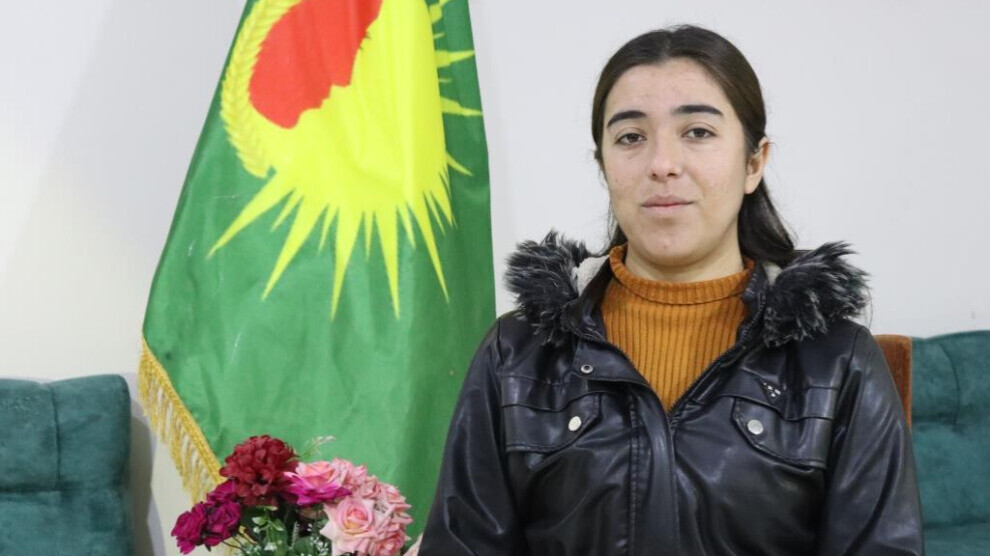
Khanaf Khalil warned that the interim government’s radical governance will deepen Syria’s crisis and drive the country toward further massacres impacting all societal components nationwide.
SILVA IBRAHIM
Kobanî — Jihadists of Hay’at Tahrir al-Sham (HTS) are practicing a systematic policy targeting women in the areas under their control, a policy no different from that previously adopted by ISIS. These practices come as part of attempts to subjugate women and exclude them from social participation, constituting a blatant violation of human rights.
Rojava has recently witnessed a new military escalation by HTS jihadists, leading to an increase in violations against women. The latest of these crimes was the killing of three women in the occupied city of Afrin. These developments come amid a clear disregard for international laws and an international silence regarding the violations committed by jihadists during their recent attacks on the region. Activists have described these acts as amounting to war crimes, emphasizing that the continuation of such violations is a dangerous indicator pushing the country toward a deeper crisis than it already faces.
In this context, Khanaf Khalil, a member of the Coordination Committee of Kongra Star in the Euphrates Canton, confirmed that the region has recently experienced military escalation by HTS jihadists aimed at annihilating peoples and sowing hatred among components that have long coexisted under the umbrella of the Democratic Nation project. This has been carried out through media incitement and attempts to instigate civil war, particularly between the Arab and Kurdish components. “The scenes of violence that spread widely on social media reflect this policy,” she stressed, noting that such policies will fail in the face of the unity and brotherhood of peoples.
She addressed the crime of killing three women in the occupied city of Afrin, as well as killings in the city of Raqqa under the control of HTS jihadists, the incident of cutting the braid of a Kurdish female fighter, and throwing another female fighter from a building balcony. “The killing of women tops the events unfolding in Afrin, Raqqa, and all areas under the control of jihadists and mercenaries of the Turkish occupation. These acts rise to the level of war crimes, as they do not respect the laws of war or international laws and are far removed from moral and humanitarian standards.”
Revival of the ISIS Mentality
She explained that targeting women with such brutality aims to break the will of women, especially after they have become pioneers in their society at all levels. However, all these violations are rejected not only locally but also regionally and internationally. “We have witnessed global solidarity campaigns in support of the women of Rojava in this regard,” she said.
She pointed out that what Syrian cities are witnessing today is a revival of the ISIS mentality. During the period when this mindset controlled Syrian cities years ago, women were stoned, forced to wear black clothing, sold in slave markets, and subjected to kidnapping and rape. She considered that what jihadists are currently practicing against women reflects the same mentality, but through softer and different methods.
Khanaf Khalil stated that the mentality with which HTS jihadists are managing the country is nothing but an extension of ISIS’s approach, stressing that continuing to govern the country with this mindset will further deepen the Syrian crisis. “These policies will lead to more massacres, not only against the Kurdish people, but against all components of the region,” she warned.
She criticized the silent stance of the international community, saying: “We will not appeal to the United Nations or the international community to break their silence, because they have failed us with their shameful position regarding the violations against the Kurdish people and their women. We see no one worthy of appeal except the Kurdish people and their women in the four parts of Kurdistan, because solidarity and unity alone are capable of limiting these violations and guaranteeing their rights as a people and as women in Syria.” She emphasized that the unity of women across the four parts forms an inseparable chain of interconnected حلقات (links), demonstrating the strength and will of women in defeating all conspiracies against them and overcoming all obstacles through unity.
In concluding her remarks, Khanaf Khalil addressed all women, saying: “All women must raise the pace of struggle through self-training on all political, military, and intellectual levels, to become women of unbreakable will in protecting the gains of their revolution, and thus be a role model to be followed throughout the world