
“Bafore the Place Drowns” … Palestinian Women Appeal to Save Their Families from the Winter Catestrophe
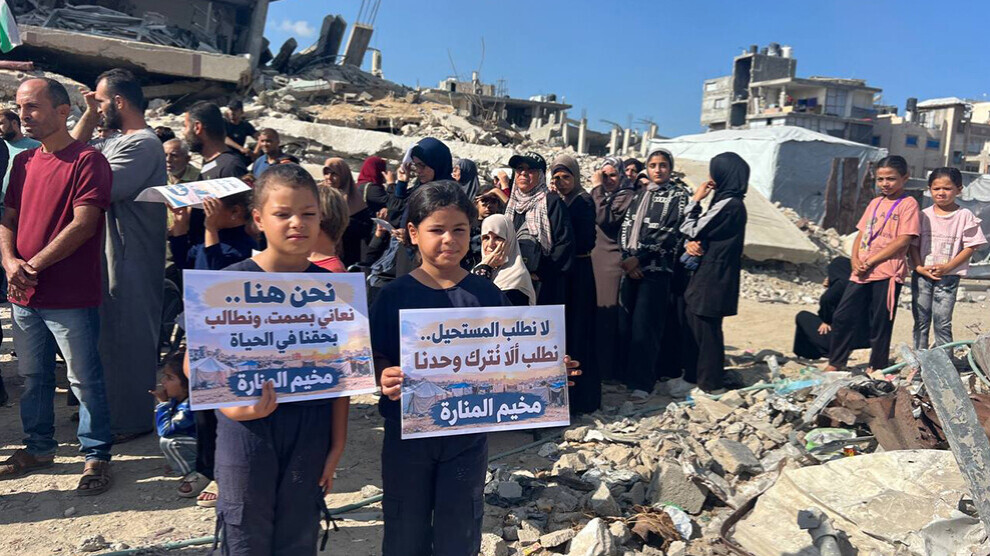
Displaced women in Gaza launched a humanitarian appeal at a peaceful stand, "Before the Place Drowns... Save the Human Being," demanding urgent international and local intervention against winter floods and drowning.
NAGHAM KARAJA
PALESTINE _ Residents, especially the displaced, in the Gaza Strip in Palestine are living under the destruction of infrastructure and sewage networks due to the war, and thousands of displaced persons lack tents fit for shelter and supplies to protect against rain and cold.
In this context, the residents of the displacement camps east of Gaza City organized today, Thursday, 22 October, a peaceful protest stand under the title "Before the Place Drowns... Save the Human Being," to appeal to local and international institutions to intervene urgently to protect them from the risks of floods and drowning as winter approaches.
The stand comes amid residents' fears of a repetition of the drowning scenes witnessed in the displacement camps during previous winter seasons, after the damage that befell the area increased the fragility of its conditions.
Amid a gathering of displaced women, Najwa Ahl stood speaking about the conditions of life inside the camp, noting that the destruction that befell the residents' homes was not followed by the provision of safe shelter alternatives, and that many families find nothing to protect them from rain and cold, at a time when their ability to meet their children's basic needs is declining.
Her fears are not limited to rainwater leaking into the tents, but extend to the details of daily life that turn into an additional hardship in the absence of lighting, especially when women and children are forced to move at night to meet their basic needs.
She noted that the municipality came and informed them that they might drown at any time. "If our staying here is dangerous, then where is the alternative place we can go to? We do not have the ability to arrange another place."
"Dilapidated Tents Do Not Provide Protection"
For her part, Inaam Shalayel, the official of women's work in the camps east of Gaza City, said that the dilapidated tents do not provide sufficient protection from rain, and that the residents need new tents, sheds, and lighting tools, confirming that the stand came to demand that local and international institutions move before a new catastrophe occurs.
She noted that everyone fears drowning as winter approaches. "If the area used to drown previously, then how will the situation be today after the war and the destruction of sewage networks? The tents are dilapidated, and sufficient support has not reached us." She added that the damage affected most of the buildings in the area, and that families are living amid the traces of destruction without a response commensurate with the scale of their needs.
As for Harba Khalil, she sums up the suffering of the families in a scene of a destroyed house and a fabric tent that cannot withstand the rain, and says: "We want the institutions to look at us and help us, not just film our suffering and then leave."
"We No Longer Have Dignity"
In another testimony, displaced woman Najah Tawfiq expressed her feeling of loss of security after years of repeated displacement, noting that the tents sheltering the families are no longer able to provide the necessary protection, and that children live in constant fear of a repetition of drowning.
She added: "We displaced several times and then returned, but where do we go now if the water floods the place? We may not even find a blanket to protect us from the cold," demanding that the concerned authorities "provide tents and find a solution that protects us before the water floods us."
From a Human Rights Perspective
Providing adequate shelter and protection from flood risks, alongside water, sanitation, and lighting, constitutes an essential part of protecting the dignity and safety of the displaced, according to relevant humanitarian principles. The expected risks call for taking urgent preventive measures, with special attention to the needs of women and children. Any evacuation measures should take into account the safety and dignity of the residents, and should be coupled with safe and adequate shelter alternatives, instead of leaving families before the risk of drowning without realistic options.
Between dilapidated tents, destroyed houses, and damaged sewage networks, the residents of the camps and affected homes await a response that precedes the rainfall, not a movement that comes after the catastrophe occurs. Their message, carried by the stand, is clear: Saving the human being begins with securing a shelter that protects them, and taking measures that prevent winter from turning into a new wave of suffering and displacement.