
As-Sweida... Youth Training in Reed-Weaving to Support a Culture of Environmental Nonviolence
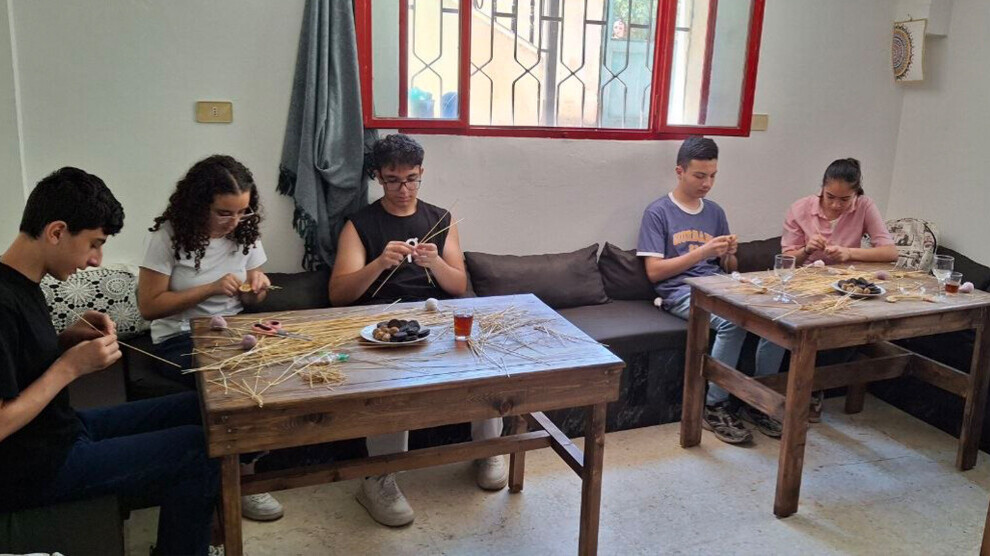
As part of initiatives promoting nonviolence and reviving traditional crafts, the "La 'Younak Ya Balad" team in Sweida trained youth in reed-weaving, encouraging natural-resource use and offering environmental and economic alternatives amid the hardships.
ROCHELLE JUNIOR
As-Sweida — Participants in the reed-weaving training called for strengthening a culture of nonviolence by reviving traditional crafts, making use of available natural resources, and encouraging young people to learn, hold on to knowledge, and confront both economic and environmental violence through eco-friendly alternatives that support self-sufficiency.
The "La 'Younak Ya Balad" team held a training session yesterday, Friday, July 24, for young people in reed-weaving, part of a series of trainings and initiatives the team carries out to promote a culture of nonviolence, encourage young people to learn and make use of available natural resources, and revive traditional crafts to protect them from disappearing.
Reviving Heritage
Nisreen Makarem affirmed that the initiative aims to revive heritage and preserve a craft at risk of disappearing, by teaching it and passing it on to future generations. She added that the displacement the region has experienced caused many families to lose their homes and belongings, including furniture and tools, prompting young people to consider using reeds to make alternative tools and encouraging people to make use of available materials to meet some of their needs.
Makarem explained that the training comes within the broader conversation on economic and environmental nonviolence, as young people see reed-weaving as a form of resistance to economic and environmental violence, being an eco-friendly craft that allows harmful plastic tools to be replaced with reed-made ones that can be used for long periods.
She also explained that the idea of screening the film The Boy Who Harnessed the Wind during the session stemmed from the difficult conditions Sweida is experiencing, and the use of the right to education as a political tool to pressure the city's residents, stressing that education is a human right.
She added that the goal of screening the film was to convey a message affirming the importance of holding on to knowledge and continually pursuing it as a path to salvation, noting that the film's basis in a true story strengthens its impact on young audiences.
"Lasts a Hundred Years"
Hala Al-Jabr said that preserving natural resources is achieved by making use of reeds and turning them into useful tools, rather than leaving them as a fire hazard or letting them go to waste over time, noting that reed vessels can be made that last up to a hundred years.
She added that this craft allows the use of ancestral methods that remain fundamentally useful, stressing the importance of spreading this knowledge, since what she learns in the course can be passed on to her family members, who can in turn pass it on further. She can also share what she has learned with her schoolmates, spreading what she has come to know about the culture of nonviolence and environmental nonviolence.
"Confronting Economic-Environmental Violence"
For her part, Catherine Ruslan, 16, also from the "La 'Younak Ya Balad" team, said participants learn during the training how to make vessels from reeds, considering this craft a contribution to achieving self-sufficiency through handicrafts, while at the same time replacing environmentally harmful materials with natural, eco-friendly ones.
She noted that today's lifestyle, which has become heavily dependent on mobile phone use, can lead to forgetfulness, stress, and distraction, while handicrafts help develop patience and the ability to regulate and release emotions in a healthy way — thereby contributing to embedding a culture of nonviolence.
She added that environmental nonviolence means protecting all living beings, and that reed-weaving allows the replacement of highly environmentally damaging materials — plastic foremost among them — with other eco-friendly materials that serve the same needs.
"Reed-Weaving Teaches Patience"
Hala Rashid, 16, said she is taking part in the reed-weaving course and spends enjoyable, useful time with her friends during it, away from being preoccupied with her phone, considering the craft also a symbol of peace, since it relies on natural materials instead of plastic and could in the future become a source of income for young people.
She explained that reed-weaving teaches patience, in contrast to the mobile phone, which pushes toward speed, and that it also builds social skills through shared experience with those around her, and helps release negative energy through handwork — skills that can be useful in practical life, noting that reeds can be turned into useful products and tools, such as chairs, tables, and baskets for storing belongings, without requiring significant material cost.
"Values Also Linked to the Concept of Nonviolence"
For her part, Tulip Abu Hjeila, 16, also from the "La 'Younak Ya Balad" team, said that the craftsperson does not break or damage the straw, but handles it calmly and skillfully until turning it into a useful product — just as, in the culture of nonviolence, a person seeks to solve problems calmly in order to reach better outcomes. She stressed that environmental nonviolence is based on replacing anything harmful to the environment with simple materials that can be turned into useful tools and products, helping to preserve the lives of living beings.