
Afrin Displaced Women in Lebanon: Massacres Repeated, But Resistance Continues
Displaced women from Afrin said attacks on Aleppo’s Kurdish neighborhoods were a planned war against Kurds and others, condemning ongoing massacres amid international silence and affirming their continued resistance.
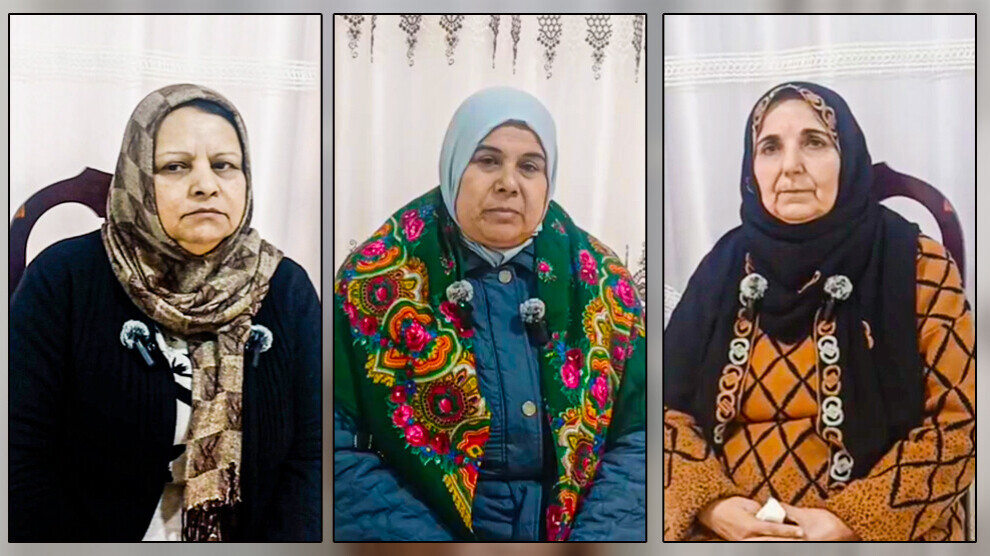
Lebanon – The Kurdish neighborhoods of Aleppo, specifically Sheikh Maqsoud and Ashrafieh, recently witnessed one of the most violent attacks, reminiscent of the massacres and repeated violations against civilians on the coast. These attacks were not merely isolated incidents, but part of a systematic and planned war targeting Kurds and all other Syrian communities, amidst a perplexing international silence that only intensifies the pain.
The attacks on the Kurdish neighborhoods were not limited to targeting fighters; they also targeted civilians, hospitals, and infrastructure. The bodies of female fighters, such as the martyr Deniz Çiya, were also mutilated.
A Systematic War
In response, Samira Bakr, who was forced to flee to Lebanon, said that what happened in the Sheikh Maqsoud and Ashrafieh neighborhoods was not just a passing battle, but a planned and systematic war, a war waged with cold-blooded minds and foreign agendas.
She describes how power was handed over to al-Julani (Ahmed al-Sharaa) with direct support from the Turkish occupation, making him a tool to implement its interests: "Bashar al-Assad's regime was overthrown because it oppressed its people, and then the jihadists of Hayat Tahrir al-Sham came to repeat the same crimes, but this time in full view of the world. What was committed in secret is now practiced openly, without deterrence or accountability."
She emphasized that the fall of the regime did not open the door to freedom, but rather brought sectarianism back to the forefront, making war a tool for managing everything through dubious alliances. She stressed that the Turkish occupation seeks nothing but the extermination of the Kurds, because the land of Kurdistan is a source of resources, and asked, "What is Turkey's connection to the Syrian interior if not to eliminate the Kurds? The Turkish president, who speaks of democracy, is practicing the most heinous forms of brutality and violation."
She recalled the massacres committed against the Alawites on the Syrian coast, where children, women, and the elderly were killed under the pretext of pursuing remnants of the regime. Then, similar crimes were committed against the Druze, while officials merely described them as "isolated incidents." She asked, "What kind of president is this who is incapable of controlling the criminals affiliated with his own government?"
She said, "The Hayat Tahrir al-Sham fighters came from different countries, were trained by Turkey, and sent to Syria to target the people. Even the March 10th agreement, which stipulated the withdrawal of the Syrian Democratic Forces (SDF) from Sheikh Maqsoud and Ashrafieh and the retention of the Asayish (Kurdish security forces) to protect civilians, did not end the suffering. Intense attacks on civilians, hospitals, and infrastructure continued under the pretext of targeting the SDF, while the fighters were sons of the city itself."
She strongly condemned the mutilation of the body of a female fighter who sacrificed her life defending her land and rights. "What religion permits mutilating bodies and killing with such brutality? They have sown discord among the people and incited hatred against the Kurds, after everyone had been living together without discrimination."
She concluded, "We will not surrender; we will not abandon our land. We will fight to our last breath to reclaim our rights and our land. We call on everyone to resist, to stand against the conspiracies, and to strive for true peace. We are against weapons, but we stand for justice and for a dignified life for our people."
“We emerged from the battle stronger and more resilient.”
Zainab Khalil, a displaced woman from occupied Afrin now living in Lebanon, condemned the massacres perpetrated in the Sheikh Maqsoud and Ashrafieh neighborhoods by Hayat Tahrir al-Sham jihadists.
She said, “The interim government, after reneging on the March 10th agreement, has put itself in a predicament. People were promised that al-Julani would bring peace and stop the violations, killings, and displacement, but reality has revealed the opposite; even more horrific and brutal massacres have been committed against all communities.”
She asked, “What have they gained from all this? Have they rebuilt Syria? Or have they transformed it into a country under radical Islamic rule that kills its own people, rapes women, and violates the rights of all communities?” She called on all human rights organizations to take immediate action, emphasizing that the attack on two neighborhoods with such massive weaponry and large numbers of jihadists is not a sign of strength, but rather a sign of fear of the residents’ resilience. “What happened was not just an attack, but an international conspiracy involving more than one country,” she asserted. She says, "In war, everyone is killed and sacrifices are made, but what sense does it make to mutilate the bodies of female fighters? What kind of barbarity is this?" She points out that Turkey and its mercenaries are repeating the same policies they implemented in Afrin, Ras al-Ayn, and Tal Abyad—policies based on occupation, violation, and the mutilation of the bodies of fighters defending their land and people.
She affirms her full support for the Syrian Democratic Forces: "The fighters in the ranks of the SDF are our childern, and we will remain their support until the end. The truth is that we did not lose the battle; rather, we emerged from it stronger and more resilient."
Scenes of Displacement Repeated
Kibar Abdo, also a displaced woman, too condemned the massacres, recalling the previous violations committed by Hayat Tahrir al-Sham jihadists against the martyr Hevrin Khalaf and the mutilation of her body, as well as what happened to Barin Kobani, emphasizing that these crimes are nothing but a continuous series of atrocities.
She questioned the reasons for the international silence regarding the massacres perpetrated in Syria by Hayat Tahrir al-Sham jihadists and the mercenaries of the Turkish occupation, asserting that this silence opens the door to further violations.
She explained how she and her family were forced to flee from Afrin to the city of Shahba, only to be targeted again and displaced a second time. She pointed out that the same scenario is being repeated today in Sheikh Maqsoud and Ashrafieh, two neighborhoods that endured years of suffocating siege. "Enough of this betrayal! Why doesn't the world's conscience stir? The residents of these neighborhoods lived together, managing their own affairs without interference. What justifies targeting them?"
She concluded by emphasizing that the Kurds seek to establish peace and democracy in the country, away from wars and conflicts, through building a decentralized system that guarantees justice and equality for all components.