
A Systematic War to Undermine the Democratic Nation Project and Silence the Call for Peace
Ongoing military escalation targets communities in North and East Syria, aiming to undermine coexistence, sabotage the Democratic Nation project, and silence Öcalan’s call for peace.
Asmaa Mohammed
Qamishlo — Rojava is today entering a pivotal stage in its history amid escalating attacks and violations targeting civilians and social components on ethnic, religious, and sectarian grounds, while the call for peace launched by Leader Abdullah Öcalan is facing an organized campaign aimed at stripping it of its substance.
Amid attempts to incite discord among components, erase Kurdish identity, and undermine security and stability, the steadfastness of local residents and their support for the Syrian Democratic Forces (SDF) emerges as a fundamental line of defense for a political project that rejects exclusion and believes that Syria cannot be built on a single color, but rather through the diversity of its peoples, identities, and free will.
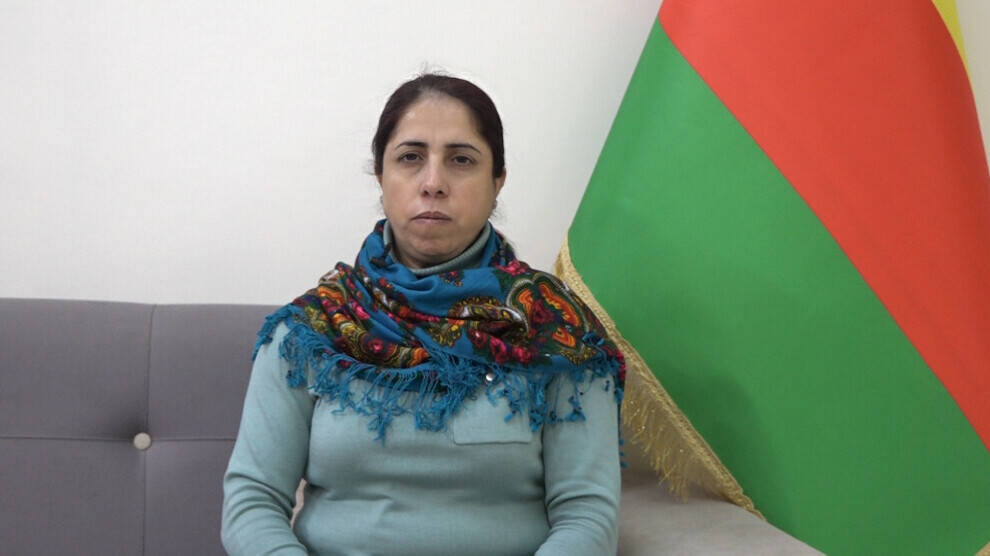
Ramziya Mohammed, Co-Chair of the Democratic Society Movement (TEV-DEM), stated in an exclusive interview with our agency that what Rojava is experiencing today cannot be separated from the broader context of the Syrian crisis, nor from efforts to sabotage any genuine democratic project that offers an alternative to the logic of unilateral power and violence.
“Current attacks carry clear political dimensions and aim to break the will of peoples who have chosen the path of freedom and self-organization instead of submission to policies of repression and marginalization,” she said.
Targeting Social Components
She added that “the fall of the former regime in Damascus and the transfer of power to armed groups with extremist tendencies has plunged the country into an extremely dangerous phase, turning Syria into an open arena for sectarian and religious conflicts. This has directly affected civilians’ lives through killings based on identity, arbitrary arrests, forced displacement, and revenge driven by religious and sectarian motives.”
She noted that these policies have particularly targeted the Alawite and Druze communities, which have suffered grave violations due to their sectarian affiliation, with civilians targeted solely for their religious difference. Such practices reproduce the most dangerous forms of exclusion and threaten Syria’s unity and its historically diverse social fabric.
She also pointed out that the North and East Syria region is simultaneously witnessing direct targeting of the Kurdish component through ongoing military escalations.
“Kurds are being targeted today because they are Kurds, and because they chose to defend their identity, pursue coexistence, and build a political model that recognizes national and religious pluralism,” she said.
Ramziya Mohammed explained that these attacks aim to erase Kurdish identity and eliminate any political or cultural gains achieved over recent years.
“These escalations do not fall within the framework of a conventional military conflict, but rather constitute part of a systematic policy aimed at destabilizing security, spreading fear among residents, forcing displacement, and emptying the region of its social essence in service of fragmentation and domination projects,” she stressed.
She emphasized that these dangerous developments coincide with Rojava entering a sensitive political phase following the proposal of the Democratic Nation project, which is based on unity among components, respect for national and religious particularities, and the construction of a participatory society founded on justice and equality.
“Yet this project is now being confronted with weapons and violence in an attempt to sabotage it and prevent it from becoming a model that could be generalized,” she said.
A Fortress of Resilience
Ramziya Mohammed noted that the region recently marked the anniversary of the liberation of Kobani, a city that became a symbol of popular resistance against terrorism.
“The people who confronted ISIS and defeated it remain committed to the option of legitimate self-defense and stand united alongside the Syrian Democratic Forces and security forces,” she said.
She explained that Kobani continues to suffer from a suffocating siege, as part of longstanding policies imposed on the city despite the sacrifices of its sons and daughters in the fight against ISIS.
“Today, the city faces renewed attempts to break the will of its people and undermine their resilience. The declaration of general mobilization by residents and their alignment with the SDF reflects collective awareness and a firm popular will to defend land and identity. These forces represent the first line of defense for civilians and the main guarantee against security collapse,” she added.
Targeting Civilians
Ramziya Mohammed addressed the intense military escalation and tight siege imposed on the Sheikh Maqsoud and Ashrafieh neighborhoods, which resulted in civilian casualties and the displacement of thousands of families under harsh humanitarian conditions.
“Children, women, and the elderly suffered from cold, hunger, and a lack of basic services. The violations committed in Sheikh Maqsoud and Ashrafieh—killing, siege, starvation, and direct targeting of civilians—constitute documented crimes against humanity. International silence regarding these crimes is no less dangerous than the crimes themselves, as it opens the door to their repetition elsewhere,” she said.
She affirmed that violations were not limited to one city, but extended to several areas in North and East Syria, including Tal Rifaat, Tabqa, and Manbij, where cases of civilian killings, assaults, and violations of the sanctity of graves and martyrs’ shrines were recorded.
“These acts aim to undermine social values and historical symbolism,” she said, asking:
“Is this the Syria they seek to build— a Syria of exclusion, violence, and a single color, or a Syria of diversity and recognition of the other? What is happening today contradicts Syrians’ aspirations for freedom, dignity, and social justice.”
Inciting Discord
Ramziya Mohammed believes that the primary objective of these wars and escalations is “to sow discord and hatred among components, especially between Kurds and Arabs, and to prevent them from reaching consensus within a unified political and social framework. This ultimately aims to strike the Democratic Nation project at its roots and reproduce internal conflicts. The revolution of North and East Syria, launched fourteen years ago, was built on the will and unity of the people and on a genuine partnership with protection forces. The people who established this experience are capable of protecting it today, if they remain committed to unity and the message of peace.”
The Call for Peace and a Democratic Solution
She affirmed that the call for peace launched by Leader Abdullah Öcalan represents a clear invitation to a democratic solution and the building of a cohesive society that respects the rights of all components. However, this call has been met with military escalation and armed conflicts aimed at undermining it and replacing the language of dialogue with the language of weapons.
She addressed an appeal to the Kurdish people at home and in the diaspora—particularly in European countries—urging them to stand united alongside their people in Rojava, support their forces, and not abandon identity and land.
“Unity of ranks is the only way to thwart the schemes of discord,” she said.
In concluding her remarks, Ramziya Mohammed placed moral and legal responsibility on the international community and human rights and humanitarian organizations to stop violations and protect civilians, especially children, women, and the elderly, who pay the heaviest price in these conflicts.
“Just as Kobani was liberated from ISIS terrorism, Rojava is capable of liberating itself from all mercenary forces seeking to destroy the Democratic Nation project and undermine unity among components. The will of peoples will always remain stronger than weapons and destruction.”