
A Critical Moment for Global Security… Al-Hol Camp Left Unmonitored
With the withdrawal of the (SDF) from al-Hol camp in northeastern Syria, the area—home to tens of thousands of ISIS members—has fallen out of control. The international community’s indifference has heightened the danger in this center.
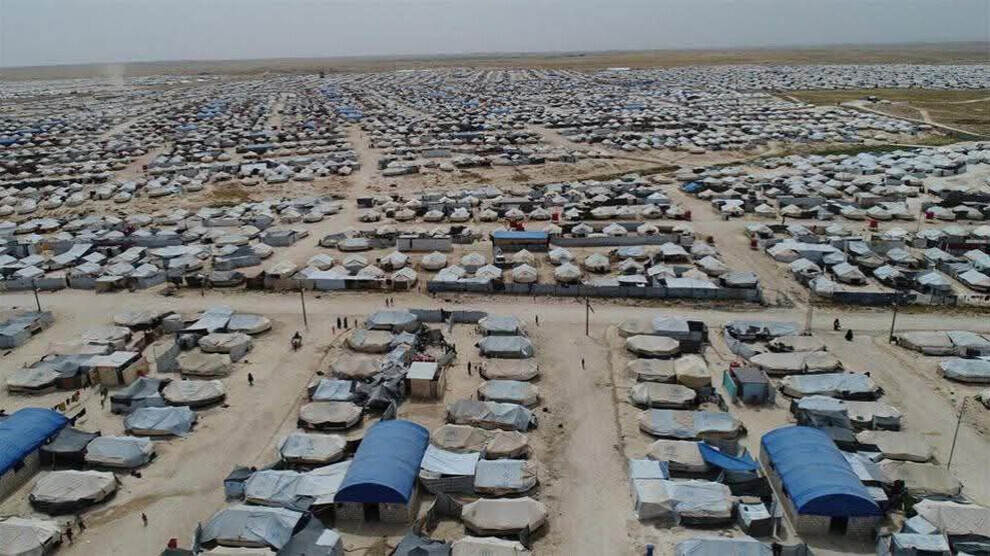
News Center – For years, the al-Hol camp has been classified as a hub of darkness threatening global security. This camp, which grew under the world’s watch in northeastern Syria, has persisted amid despair, a security vacuum, and international indifference, forming a dangerous ground where ISIS ideology is repeatedly reproduced despite all efforts.
Al-Hol was not merely a refugee camp; it was a ticking silent bomb creating future generations of extremists and threatening the region. Now, the safety valve of this bomb has been removed.
Yesterday, Tuesday, January 20, the Media Office of the Syrian Democratic Forces (SDF) announced its withdrawal from al-Hol camp, which houses families and members of ISIS.
The withdrawal, according to their statement, came due to the international community’s indifference to the ISIS issue and its unwillingness to bear responsibility in handling this highly dangerous matter. The SDF indicated that they were forced to leave al-Hol camp and redeploy around northern Syrian cities, which are increasingly facing threats and dangers.
Establishment and Expansion
Al-Hol camp is located 45 kilometers east of the city of Hasakah in northeastern Syria. It is the largest refugee camp in the region, established in 1991 following the Second Gulf War.
After the Syrian Democratic Forces (SDF) liberated the town of Al-Hol in 2015, the camp began receiving Syrians fleeing pressures from the Damascus government and ISIS. Following the liberation of Mosul in 2016, Iraqi refugees also began arriving at the camp.
Initially, the camp accommodated wives and children of ISIS members who had surrendered or were captured within refugee sections in the camps of Roj, al-Hol, and Ain Issa. Due to emerging issues, separate sections were allocated for ISIS families within al-Hol and other camps.
The camp expanded rapidly following the “Operation Island Storm” in March 2019, particularly after the liberation of the Baghuz area, the last ISIS stronghold in Syria, when thousands of surrendered ISIS families were transferred to al-Hol.
Moreover, the Turkish attack on the KRI Sbe / Tal Abyad area on October 9, 2019, and the targeting of Ain Issa camp caused dozens of ISIS-affiliated women to flee, prompting the transfer of nearly 3,000 women and children from ISIS families to al-Hol, further increasing the camp’s size and danger.
Camp Structure and Demographics
Al-Hol’s population has fluctuated significantly; after reaching 80,000 residents, numbers decreased thanks to efforts by the Autonomous Administration to facilitate the return of Syrians whose identities were verified and who were not involved in terrorist acts, as well as an agreement with Iraq to repatriate thousands of Iraqi refugees.
According to journalists and local officials, the camp is divided into six sectors: three for Iraqi refugees, two for Syrian refugees, and one sector specifically for foreign women and children of ISIS.
More than 7,000 individuals were affiliated with ISIS, mostly women and children, with over a thousand adult men. The ISIS women’s section was designed as a “camp within a camp” to prevent its expansion and operational activities, including its own doctors, market, and hospital, with complete isolation and prohibition of movement between it and other sectors.
As of April 2025, al-Hol camp hosted 3,829 Iraqi families, 4,351 Syrian families, 1,895 foreign families, and 9 stateless families.
Crimes and Executions
Al-Hol camp has frequently made headlines in recent years due to ISIS dominance within it. The camp, posing a major threat to its residents and regional security, became a center for training and organizing by ISIS cells, especially with infiltration by ISIS men.
ISIS-affiliated women established an internal branch of the so-called “Hisbah” – a unit responsible for punishing anyone who did not comply with strict rules. Women who tried to defect from extremist ideology, refused to raise their children according to ISIS teachings, or resisted wearing the black niqab, were subject to execution.
Since 2019, hundreds of crimes and massacres have been documented within the camp. Despite numerous security operations by the Internal Security Forces of northeastern Syria, ISIS members continued to eliminate dozens who refused to follow the extremist path or sought to leave these cells, using brutal methods.
Official data from the camp’s administration reported the following death tolls: 13 in 2019, 32 in 2020, 96 in 2021, and 44 in 2022.
Security Operations Within the Camp
Since March 28, 2021, the Internal Security Forces of northeastern Syria, the Women’s Internal Security Forces, the Women’s Protection Units (YPJ), and the Syrian Democratic Forces (SDF) have sought to curb ISIS cell activities through a series of security operations inside the camp and its surroundings.
These operations resulted in numerous arrests of terrorists: 125 in the first operation, 226 in the second, 85 in the third, and 79 in the fourth. ISIS members involved in murder and torture were detained. The forces also discovered tunnels leading outside the camp and confiscated hand grenades, heavy weapons, knives, and ammunition.
On the humanitarian side, the YPJ’s efforts to rescue Yazidi women from ISIS captivity in the camp became a “beacon of hope” in extremely harsh conditions, saving several Yazidi abductees.
International Neglect
Countless appeals have been made regarding the situation in al-Hol camp and its residents, yet international institutions and concerned states turned a blind eye. Despite repeated calls to establish independent international courts to try these elements, no tangible steps have been taken.
Repeated calls have urged countries to repatriate their citizens among ISIS women and children in al-Hol and Roj camps, but states have avoided responsibility. Of dozens of involved countries, only 36 repatriated a very small portion of their citizens.
This inaction has allowed radicalism and extremism to intensify among camp residents. Despite efforts by women’s organizations in the Autonomous Administration areas to rehabilitate and reintegrate ISIS women, these attempts were insufficient in the face of the magnitude of the tragedy and lack of international support.
Time Is Running Out and Threats Escalate
Today, al-Hol camp is considered one of the most complex and dangerous places in the region. It is a center for reproducing extremist ideology and a clear threat not only to Syria but to the entire world. Now, this threat has escaped control.
In this place, the heart of ISIS danger, time is racing against the world at an alarming pace. Furthermore, the world may now face “more educated and trained” violence, considering the organizational and educational activities ISIS carried out within the camp. The international community, which yesterday refused to bear responsibility and ignored the situation, is primarily accountable today for what has occurred and for potential future disasters