
Sab’a Foundation concludes its activities by launching initiatives that enhance women’s role in development
In Taiz, Sab’a Youth for Development Foundation completed a four-month project: empowering women’s organizations in peacebuilding and recovery, developing capacities, launching initiatives to strengthen women’s presence in development and society.
Rania Abdullah
Yemen – Participants agreed that the project constituted a real boost for empowering women's organizations, by developing their technical and institutional capacities and providing broader opportunities for women to engage in peacebuilding and development initiatives.
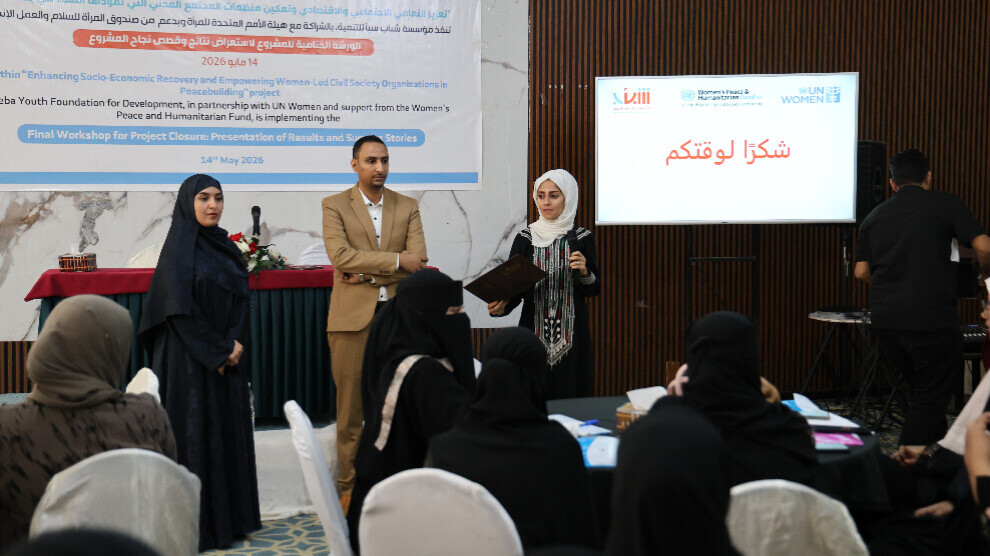
The "Sab'a Youth for Development" Foundation, in partnership with UN Women and the Women's Peace and Humanitarian Fund, concluded yesterday, Thursday, May 14, in the city of Taiz, southwestern Yemen, the project "Enhancing Social and Economic Recovery and Empowering Women‑Led Civil Society Organizations in Peacebuilding." During the workshop, exceptional outcomes and success stories were presented, reflecting women's ability to lead and achieve technical and social transformation under war conditions.
The project, which lasted for more than four months, targeted four women‑led civil society organizations in the city of Taiz, aiming to bridge the gap between emerging and large organizations, integrate technology into humanitarian work and peacebuilding, in addition to targeting 30 young men and women in the technical field and business development.
Leadership and technical empowerment
Arwa Al‑Omari, Director of the Businesswomen's Department at the Chamber of Commerce and Industry, affirmed that the project contributed to supporting youth and women's organizations to become self‑reliant and develop startups that keep pace with the next stage, pointing out that training 30 young men and women is a fundamental pillar for developing the local labor market with the presence of strong women's incubators.
For her part, Areej Al‑Absi, Executive Director of the "Reef for Human Development" Foundation, explained that the grant provided to her organization brought about a qualitative shift in its performance, enabling it to launch a digital awareness project in Al‑Ma'afer District targeting 16 young men and women, in addition to providing the organization with modern accounting systems and a Starlink device to overcome communication obstacles. She affirmed that the project opened new horizons for networking and building relationships with donors and active institutions. "We launched a website thanks to networking with technicians whom the Sab'a Youth Foundation qualified and connected us with."
Green Mediation
In the context of enhancing women's role in conflict resolution, Zainab Al‑Makhhlafi, head of the "Judn for Development and Peace" organization, pointed out that the organization implemented the "Green Mediation" project to protect agricultural lands from flood risks and trained 20 people from local authorities and community committees in mediation skills. "The project enhanced the organization's technical capacities in the fields of cybersecurity, strategic planning, and writing project proposals that meet international donor standards."
An integrative vision
For her part, Kawthar Al‑Sabaie, project coordinator at the "Sab'a Youth for Development" Foundation, affirmed that the foundation deliberately targeted women's organizations because of its belief in the pivotal role of women in completing the development process. She noted that the project included the "Tech Leaders" program, which integrated technology skills with life skills and worked to connect these leaders with women's organizations to develop websites and strategic plans, thus creating an "integrative process" that serves sustainable peacebuilding.
It is worth noting that the project focused intensively on reducing gender gaps in civil society and providing women with the necessary technical and financial tools to lead development interventions in both rural and urban areas alike, thereby strengthening the resilience of emerging women's institutions in the face of current challenges.