
Simge Yardımcı: What is happening in schools is a direct result of the existing system and its policies
Simge Yardımcı of the Education Union said the attacks in Urfa and Maraş aren’t isolated but reflect long-standing policies that worsen violence. The solution is radical educational reform to build a democratic, safe environment.
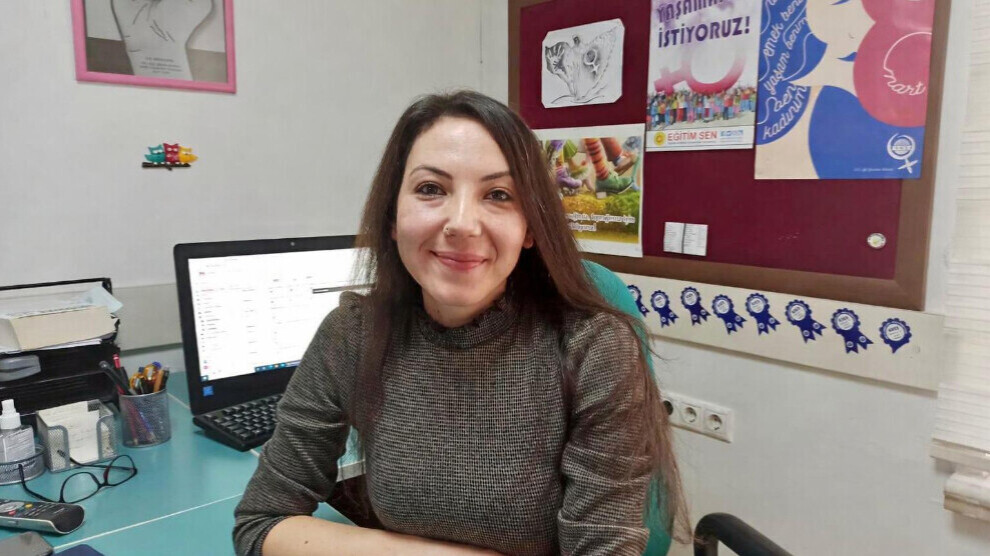
Elif Akgül
News Center — The district of Siverek in Urfa, North Kurdistan, witnessed an armed attack targeting a high school, while a 13-year-old child carried out a similar attack at a middle school in Maraş, bringing the debate over violence in educational institutions back to the forefront.
A 19-year-old young man entering a school in Siverek and opening fire, and a younger child carrying out an attack that resulted in many casualties in Maraş, have raised questions about whether these incidents are isolated or part of a broader pattern. The two events have sparked a wide discussion about educational policies, child protection, and the societal climate regarding violence.
Simge Yardımcı, Secretary of the Women's Secretariat at the Education Union (Eğitim-Sen), who was in Urfa following the attack, stated that behind these two assaults lie policies that have been implemented for a long time. She noted that the education system is being shaped in a direction that does not respect children's rights or democratic values, which deepens feelings of despair, a tendency toward violence, and a lack of hope among young people.
She also pointed to impunity policies and the spread of individual gun ownership, which facilitate children's access to tools of violence, emphasizing that the solution lies not in security approaches but in an approach based on educational and societal transformation.
"The Two Incidents Are the Result of Power Policies"
She explained, "These two incidents are the result of policies that have been implemented for a long time," adding, "We have repeatedly stated this, both regarding the policies of the ruling power and the Ministry of National Education, and we predicted that the future of all policies imposed on society as a whole would pass through this."
She noted that the appointment of Yusuf Tekin as Minister of National Education marked a turning point, as "the ruling power began to view education as a tool for ideological construction."
Simge Yardımcı directly links educational policies and the content of the education system to the problems experienced by young people: "When we look at the curricula, projects, and protocols, we find ourselves facing an education policy that does not respect children's rights, is not based on democratic, peaceful, and egalitarian education, but rather is built on a single identity and a single culture, deepens gender discrimination, and does not take children's rights as its foundation. This has led to the development of a culture of violence among children, an increase in gendered approaches, and the deepening of various forms of discrimination."
She added, "Children within this education system do not feel their own value, nor do they experience their existence through their rights. Today we see that young people suffer from a serious problem of hopelessness and lack of horizon. All of these are factors that affect them psychologically; and when we look at the recent period, we also see that youth suicides have increased in parallel with these events."
Impunity and Normalization of Violence
Simge Yardımcı drew attention to a broader climate of societal violence, noting that this climate has begun to appear in various areas: "We also observe that drug use and addiction among young people are starting to spread increasingly. Each of these indicators was a warning. At the same time, we are facing a dangerous social climate of violence. We see it in violence against women, and we also see it in cases of exploitation of children. There is a policy of impunity. There is a normalization of violence. Perpetrators are not punished; as a result, widespread violence becomes legitimized."
In this context, Simge Yardımcı rejects viewing children as perpetrators, affirming that the responsibility is "systemic" and that what is happening must be addressed within a broader framework: "But when we look at it from the children's perspective, many consider children to be perpetrators and assign them responsibility reduced to the child's own level. However, here we are talking about a 13-year-old child and a 19-year-old young man in Siverek. Thus, it can be said that the responsibility for these children reaching this state at the ages of 13–19 falls entirely on this system."
She stressed, "Instead of holding children responsible, we must rebuild the system and characterize it correctly based on these two incidents, and clarify what the new societal construction should look like. These children did not arrive at this point from nowhere or only because of psychological disorders. There are many factors that need to be evaluated so that this violent climate does not become a factor that increases polarization."
"Children Have Gained Access to Weapons"
Simge Yardımcı believes that the spread of violence cannot be separated from the polarization-based political discourse nor from the proliferation of individual gun ownership, saying, "For this reason, the level of children's access to weapons has emerged as a critical problem."
She continues, "The polarizing discourse used by the ruling power, along with years of ongoing war policies, creates a ground that gives this situation a kind of legitimacy. As a result of this extended polarizing policy, individual gun ownership has spread significantly, and with it reaching this level, children have become able to access weapons. This is a very serious problem. That children can access weapons so easily, that they can enter a school and easily open fire on students and teachers, and then attempt suicide afterward — all of this requires deep societal analysis and a strong struggle."
"The Minister of National Education Must Resign"
Simge Yardımcı affirmed the necessity of a radical change in educational policies, stressing the need for an educational and democratic framework instead of security-based approaches: "The Minister of National Education, who created this problematic situation, which led to the deaths of children and paved the way for what we witnessed today in Siverek and Maraş, must resign. Educational policies must also be redesigned in a way that includes the demands of education workers, students, and parents."
She noted that opposition to current policies is always met with the issue of security: "Safe schools must be created; but at the Education Union, we are not talking about security that can be achieved through private security guards or police. A safe environment cannot be created through private security; the presence of uniformed personnel inside schools creates greater educational problems for children."
She added, "The number of psychological counselors in schools should be increased, an education system should be built in which children can express themselves, and policies should be developed to help children get rid of anxiety about the future and feelings of hopelessness."
"When a Discourse of Peace Prevails, the Language of Education Will Also Turn into a Language of Peace"
Simge Yardımcı also addressed the issue of resolving the Kurdish question and the path to democracy, affirming that peace and its discourse are a necessity for the future of education and children: "Because schools will move toward democracy in a democratic society. Children's lifestyles will change, as will young people's lifestyles. And in an environment where a discourse of peace prevails, the language of education will naturally develop into a language of peace. This is one of the most important points for children, because education concerns the whole of society."
"Guarding Life" Sit-in
She noted that the Education Union will organize a three-day sit-in in front of the Ministry of National Education under the title "Guarding Life," affirming that this step is just the beginning and that the struggle must be waged with the participation of all segments of society: "Everyone must take their responsibility without considering these incidents as isolated events, so that all officials are held accountable. Because those responsible for these incidents are not the 19-year-old and 13-year-old children, but the system that created this reality. In a time when femicides are increasing, young people are being driven to suicide, and children are becoming inclined toward violence to this extent, everyone must take responsibility for the future of the entire country."