
Roubar Majeed: Self-knowledge and women's freedom are the essence of leader Öcalan's theses
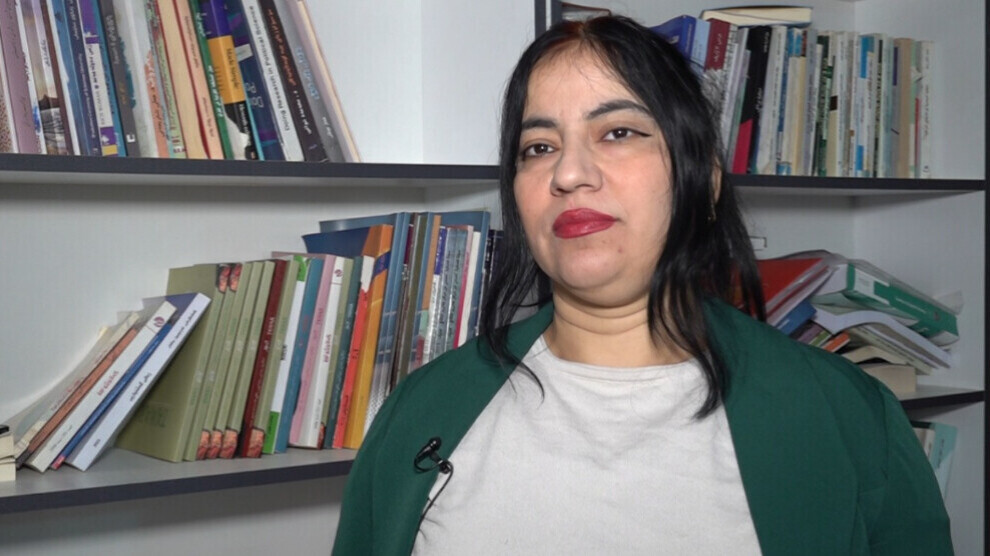
Roubar Majeed, a law professor at the University of Sulaymaniyah, affirmed that the essence of any successful educational process begins with individual training and women's freedom, which, in her view, are the two fundamental pillars of leader Öcalan's t
Haifa Salah
Sulaymaniyah — The history of the education system in the Kurdistan Region has been subject to direct influence from central government authorities, and later from political conflicts, rendering knowledge in service of the labor market and political interests rather than in service of human freedom. Therefore, there is an urgent need today to change the educational philosophy in a way that makes values such as women's freedom, environmental protection, and building a democratic society the foundation of academic institutions, in order to overcome the constraints that have bound scientific centers.
The formal education system in the Kurdistan Region remains caught between the classical Western model and local social and customary influences. This has led to a clear gap between society's needs and what is taught within scientific institutions.
In social philosophy, training is considered an essential tool for human liberation, as a society lacking an independent and developed training system cannot determine its destiny. Hence the importance of those messages that emphasize essential training, viewing that a free human being cannot be raised without democratic education away from the authoritarian mentality.
However, when looking at the reality of the Kurdistan Region, we see that despite attempts to benefit from this type of thought, especially within informal cultural centers, the educational system at the level of formal and governmental institutions remains subject to traditional models and political interests, and has been unable to transform those messages calling for restoring society's true identity, women's freedom, and environmental protection into the basis for a genuine educational reform process.
This is most evident in higher education institutions and universities, which are supposed to be leading academic centers for change, but they have often become places for reproducing theoretical knowledge rather than spaces for critique and creativity, and have become distant from society's real problems.
This situation has led to universities' inability to fulfill their historical role in changing individual mentality and developing societal knowledge. Therefore, there is an urgent need for radical change in educational philosophy, so that knowledge becomes in service of humanity and freedom, not merely a technical tool for the labor market.
In this context, progressive philosophical theses can form a roadmap to rescue the university from the constraints that bind it, leading to a generation possessing independent will and thought, capable of facing future challenges.
No individual liberation without social liberation
According to the philosophy of leader Abdullah Öcalan, the process of educating society and the free individual is the fundamental pillar of all radical transformations. The capitalist modernity system cannot be confronted without deep intellectual and cognitive training. For Öcalan, training is not merely learning to read and write; it is a process of self-knowledge and returning to the truth of the human being and society, which have been distorted by thousands of years of power domination.
Öcalan emphasizes that an individual cannot be free if their society is not liberated from intellectual and social constraints, and conversely, a society cannot be free without conscious individuals possessing will. Individual freedom and societal freedom are intertwined; one cannot be separated from the other.
Women's consciousness is the cornerstone of the freedom project
Leader Abdullah Öcalan says, "The level of freedom of any society is measured by the level of women's freedom within it, because women are the first category and gender to have suffered oppression and domination throughout history." Therefore, when women are educated and reach the level of decision-making and possess independent will, the entire society moves toward freedom. Hence, Jineology, as the science of woman and life, becomes the fundamental pillar for educating a free society.
For Öcalan, Jineology is not merely a theory; it is an educational process aimed at restoring women to their true identity and authentic will. When women gain consciousness through this science, they can lead all layers of society toward genuine freedom and equality.
Individual training... protecting identity in the face of capitalist modernity
Similarly, Öcalan's concept of democratic nation is a political and social model based on multi-faceted education and peaceful coexistence among all components. It is a model that moves away from narrow nationalism and focuses on the moral and political society in which individuals learn, through democratic training, how to manage their affairs without needing a repressive central authority.
This model has made the co-presidency system a guarantee to break the monopoly of masculine power and restore balance to the decision-making structure. When men and women lead the process together and equally, the individualistic mentality recedes in favor of a participatory democratic mentality.
In this context, the concept of protecting the essence (self-protection) according to leader Abdullah Öcalan is an educational process aimed at enabling individuals to protect their identity and culture against the cultural attacks of capitalist modernity. This concept is clearly evident in the Rojava experience, where training through democratic society and Jineology academies has taught individuals a participatory way of life and made women the vanguard of the revolution. Experience has proven that when women possess free thought and will, they can achieve great accomplishments.
Self-discovery... the ultimate goal of training
Regarding the importance of training, Roubar Majeed, professor at the College of Law, University of Sulaymaniyah, said: "Undoubtedly, training is the foundation upon which all societies are built. It must begin from the family and kindergarten, through schools and universities. When training produces a conscious and sound human being, this means the educational process itself was sound and purposeful, and its goal is to build a person capable of filling society's deficiencies, not merely imparting limited classical information."
She added: "Every individual needs knowledge, especially in their field of specialization, but education must be able to transform this knowledge into service for society and bring about change in the individual's character. Education should not be just a means to obtain a certificate or reproduce old information, then get a job. Classical education produces robotic people who repeat what they are given without consciousness, lacking the ability to make serious decisions or play a leadership role."
She noted: "The certificate should be a starting point in an individual's life, not just a piece of paper. Knowledge must be used to solve society's problems. True training is what teaches a person self-knowledge, solving their problems, and facing real challenges in society. Training that does not do this is futile."
"Leader Öcalan's messages can be utilized in developing the education system"
Roubar Majeed said that educational institutions should not merely be places for granting certificates; they must bring about change in curricula and the education system: "We must produce students with critical and creative personalities. The student must pause at points they do not understand and critique the knowledge presented to them, not just memorize it to write on an exam then move to another stage. This does not produce a creative nor successful student."
She explained that modern education systems worldwide rely on developing critical thinking: "If we do not raise critical students, we will not progress. The basis of creativity is the ability to criticize."
Leader Öcalan's messages and their role in training
Regarding leader Abdullah Öcalan's messages related to training, she said: "Leader Öcalan has very important messages in the field of training and education. He sees training as a means to liberate human beings from oppressive social and political systems, and that it is the path toward building a free individual capable of influencing their people's destiny."
She pointed to the importance of mother tongue in education: "If study is not in the mother tongue, the student must demand it. Because rejecting our language means rejecting our existence and identity."
She concluded her speech by saying: "Training, like all other fields, must bring about real change and be connected to society. Without this connection, we will not be able to influence or progress. Unfortunately, we have not yet succeeded in reducing the masculine mentality in society. Therefore, change must occur to achieve balance and harmony within society. The education system must be the center and the goal, because without it, change or societal development cannot be achieved."